
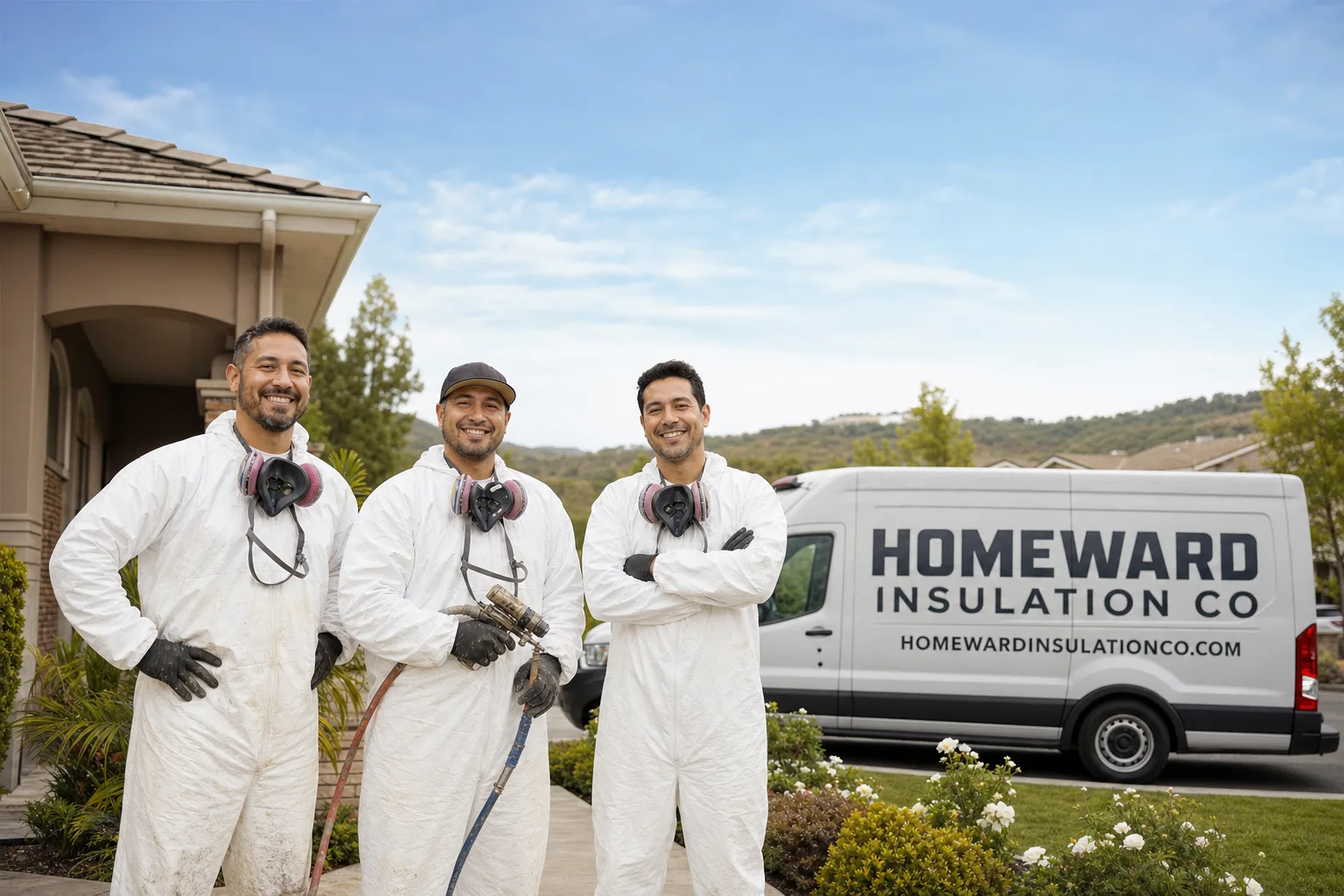
Fast, Reliable Spray Foam Insulation Across West Covina
Spray foam insulation in West Covina typically costs $2,800 – $6,400 for a full attic application, with garage ceiling projects running $1,200 – $2,600. The homes here, mostly 1950s through 1970s tract builds across the San Gabriel Valley, were never designed for the heat loads we now see every summer. That means the work usually involves more than just spraying foam. It starts with understanding what’s already in your attic, what’s failed, and what has to be addressed first. Our crews work throughout West Covina every week, from the hills above Cameron Park down to the flatlands near Nogales Street. If you’re tired of rooms that won’t hold temperature, call Neil Dorfman’s team at (855) 473-6516 for a straight answer.
Why Homeward Insulation Co Is West Covina’s Preferred Spray Foam Insulation Company
We’re insulation contractors, not generalists. That’s the whole business. When a West Covina homeowner calls us about a hot upstairs hallway or an AC that runs all afternoon, we’re not trying to sell a roof replacement or a new HVAC system. We’re looking at thermal boundaries, air leakage, and the specific failure points in a 1960s tract attic.
Neil Dorfman built this company around a material-agnostic approach. We stock and install from eight manufacturers, including Owens Corning, Rockwool, and Johns Manville. That matters in West Covina because the right answer for a 1958 ranch on South Azusa isn’t always the right answer for a 1979 two-story off Barranca. When we can pull from competing brands, we recommend what actually performs for the application. Not what we’re stuck selling.
Our response time to most West Covina neighborhoods is same-week, and many attics can be assessed within 48 hours. That speed matters when your upstairs hits 95°F by noon and you’re deciding between spray foam or another summer of portable AC units.
Garage Spray Foam Insulation in West Covina
Garage Spray Foam Insulation in West Covina usually means addressing a garage ceiling that sits directly below a bedroom or living space. In these 1950s – 70s tract layouts, that garage ceiling is often an uninsulated drywall plane with a thin layer of whatever fell off the attic floor above it. The result is a bedroom floor that’s cold in January and a garage that radiates heat upward all summer.
We see this constantly in the 91791 and 91792 zip codes, where garage-conversion projects were popular decades ago and the thermal boundary got murky. A typical garage ceiling spray foam job in West Covina runs $1,200 – $2,600 depending on square footage and whether we’re sealing rim joists at the same time.
What Gets Sealed First
Before any foam touches the ceiling, our crew checks the rim joist area where the garage ceiling meets the exterior wall. That seam is a major air path in West Covina homes, especially on north-facing garages off Citrus Avenue where wind-driven air finds every gap. Closed-cell foam here does double duty: it air-seals and adds structural rigidity.
When Homeowners Call Us
Most garage calls come in late July and August, when the San Gabriel Valley heat turns an attached garage into a convection oven and the room above it becomes unusable. But the best time to do this work is actually spring or fall, when scheduling is faster and the foam cures under ideal temperatures.
Closed Cell Spray Foam Insulation in West Covina
Closed Cell Spray Foam Insulation in West Covina is the workhorse for attics with limited depth, and that describes a lot of the city’s older homes. Closed-cell delivers roughly R-7 per inch, which means a 2×6 rafter bay can hit R-25 or better without eating the whole cavity. For West Covina homeowners dealing with 100°F+ attic temps, that density matters.
A full closed-cell attic application in West Covina typically runs $3,800 – $6,400. Smaller rim joist or scuttle-hatch projects start around $900. We’re an Icynene and Demilec installer, so you’re not locked into one formulation. Some attics do better with a hybrid approach: closed-cell for the air seal on roof decks, then open-cell or blown-in for the fill. That’s exactly the kind of call we make after inspecting your specific roofline.
Why Density Matters in Your Attic
Closed-cell foam acts as a vapor retarder and an air barrier in one pass. In West Covina’s dry summer heat, that’s less about humidity and more about stopping superheated attic air from migrating into living space. The foam also adds rigidity to older roof decks, which helps on 1960s homes where the original plywood has dried and started to move.
When Retrofitting Beats Replacing
If your attic still has the original 1×6 skip sheathing or a jerkin-head roofline common in some West Covina hillside builds, closed-cell spray foam is often the best retrofit option. It conforms to irregular framing better than batts, and it doesn’t require tearing out the existing ceiling. You’re adding thermal performance without turning a two-week job into a full gut.
Trusted Brands We Service in West Covina
We install both Icynene and Demilec spray foam systems, and we carry Owens Corning, Johns Manville, and Knauf batts for hybrid jobs. That breadth means we’re not trying to make one SKU fit every attic in West Covina. We stock the materials for most residential jobs locally, so turnaround on a typical attic or garage project doesn’t stall waiting on a distributor truck. If your job calls for a specific product, Neil can tell you honestly whether it’s the right call or whether a competing product would do the job better for less money.
Common Spray Foam Insulation Problems We See in West Covina Homes
- Settled fiberglass batts in 1950s – 60s attics. The original insulation in these homes has compressed to two inches or less, leaving uninsulated gaps at the eaves and top plates. On a 100°F day, that’s a direct path for radiant heat into the ceiling below.
- Uninsulated plywood scuttle hatches in hallway closets. We find this on almost every original West Covina tract home. The hatch acts like a chimney, pulling conditioned air into the attic and pushing hot air down. Sealing it with closed-cell foam is the first move, before any rafter bays get sprayed.
- Knob-and-tube wiring in older neighborhoods. Some West Covina attics still carry original knob-and-tube circuits. Foaming over live K&T wiring is a code violation and a fire risk. We reroute or abandon those circuits first, then foam the bay. It adds a step, but it’s non-negotiable.
- Unsealed rim joists and top plates. Even if the attic floor is insulated, the perimeter is often wide open. That’s why a spray foam job that skips rim sealing might only deliver half the comfort improvement it should.
Pricing for Spray Foam Insulation in West Covina, CA
In West Covina, a garage ceiling spray foam job lands between $1,200 and $2,600. A full closed-cell attic retrofit, including scuttle-hatch sealing and rim joist work, typically runs $3,800 to $6,400. Smaller targeted work, like sealing a single bay or an attic access hatch, starts around $900. What changes the final number: attic square footage, whether knob-and-tube wiring needs to be addressed first, foam thickness, and whether we’re doing a hybrid closed-cell/open-cell setup. Every estimate is free and we give you the total before any work starts. Call (855) 473-6516 and we’ll have someone out to measure your attic and give you firm numbers.
We Also Serve Cities Near West Covina
Along with West Covina, our crews regularly work in Valinda, South San Jose Hills, La Puente, and Covina. Same crew, same material-agnostic approach, same focus on older tract-home attics that need more than a quick batt replacement. If you’re anywhere in the eastern San Gabriel Valley and want an honest read on your insulation, we’ll make the drive.
Serving West Covina, CA — Our Local Coverage Area
We’re based in the West Covina area and know this community well. Use the map below to see our service coverage — if you’re nearby, we can almost certainly help.
FAQs About Spray Foam Insulation in West Covina
Spray foam air-seals as it insulates. In a 1960s West Covina tract home, the original fiberglass batts have settled to a fraction of their original depth, leaving gaps at eaves and top plates that air flows straight through. Adding more fiberglass on top doesn’t stop that airflow; it just covers it. Spray foam, especially closed-cell, fills those gaps and creates an air barrier at the same time. For most of these attics, the air sealing is worth more than the R-value bump. Call (855) 473-6516 and we’ll explain exactly what your attic needs.
Yes, but only after the wiring is addressed. Spray foam applied directly over live knob-and-tube wiring traps heat and creates a fire risk, and it’s against code. In West Covina homes where we find K&T, we either reroute the affected circuits or abandon them and run new Romex. That adds a day or two and some electrical cost, but it’s the only safe way. A homeowner on South Lark Ellen Avenue recently had this exact situation in two rafter bays, and the job came out right because we didn’t cut corners.
A small spray foam application directly on the attic side of the hatch is the best fix. We cut a piece of rigid foam board to fit, spray closed-cell foam around the perimeter to seal the gap, and add weatherstripping to the hatch lip. In West Covina tract homes, the plywood scuttle in a hallway closet often leaks more air than the entire attic floor. Sealing it takes less than an hour and it’s the first thing we do before any larger attic work.
Yes, and it’s one of the biggest reasons homeowners here choose it. West Covina’s diurnal swing is brutal on homes: daytime attic temps can exceed 140°F, then drop near freezing on a January night. Spray foam creates a continuous air and thermal barrier that keeps that heat out in summer and slows overnight heat loss in winter. After we sealed and foamed a 1962 home off South Lark Ellen Avenue, the owner saw a 104°F day cap at 78°F inside with the AC cycling half as often. That’s the kind of change you feel immediately.
We start at the rim joists and the ceiling plane, sealing every seam where air moves between the garage and the rooms above or beside it. If you’re using the garage as a workshop or the room above it gets too hot, closed-cell foam on the ceiling is the right call. In attached West Covina garages that share a wall with the house, we also address that common wall. A garage ceiling job runs $1,200 – $2,600 depending on size, and we can usually knock it out in a single day. Call (855) 473-6516 for a free garage assessment.
Contact Homeward Insulation Co for Spray Foam Insulation in West Covina
If your West Covina home has an attic that bakes all summer, walls that won’t hold heat in winter, or a garage that’s unusable by midday, we’ll take a look and tell you honestly what’s worth doing. You’ll get firm pricing, a clear explanation of the right material for your home, and a crew that treats your 1960s tract house like the specific building it is, not another job. Call Neil Dorfman’s team at (855) 473-6516 for a free estimate. We cover all of West Covina, including 91790, 91791, 91792, and 91793.
Written by Neil Dorfman, Owner at Homeward Insulation Co, serving West Covina and the eastern San Gabriel Valley.