Attic Insulation Cost Guide: What Portola Hills Homeowners Pay in 2026
Most Portola Hills homes need attic insulation work in the $1,800 to $6,200 range in 2026, with the average job landing around $3,400. That’s a wide spread, and the reason isn’t the insulation itself. It’s what’s actually in the quote: access difficulty, air sealing, old insulation removal, and whether the contractor bothered to include baffles at the eaves. If you’re comparing numbers without comparing scope, you’re not comparing anything. Need a straight answer for your house? Call (855) 473-6516 and we’ll walk you through it.
What Attic Insulation Actually Costs Per Square Foot in Portola Hills
Here’s the number most guides skip: material cost per square foot is the smallest variable in your quote. Labor to reach the attic, prep it, and deal with what’s already up there drives the final price far more than whether you choose fiberglass or cellulose. But you still need baseline numbers to know if you’re in the right ballpark.
For Portola Hills homes targeting R-38 to R-49 (the range recommended for CEC Climate Zone 8, which covers our area), here’s what we’re seeing in 2026:
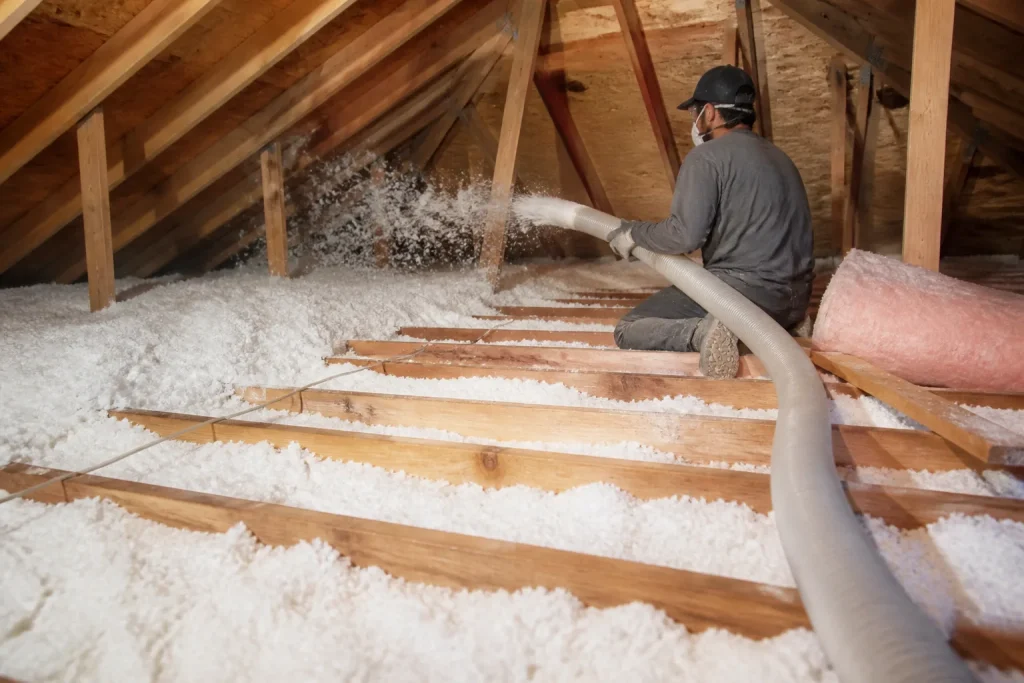
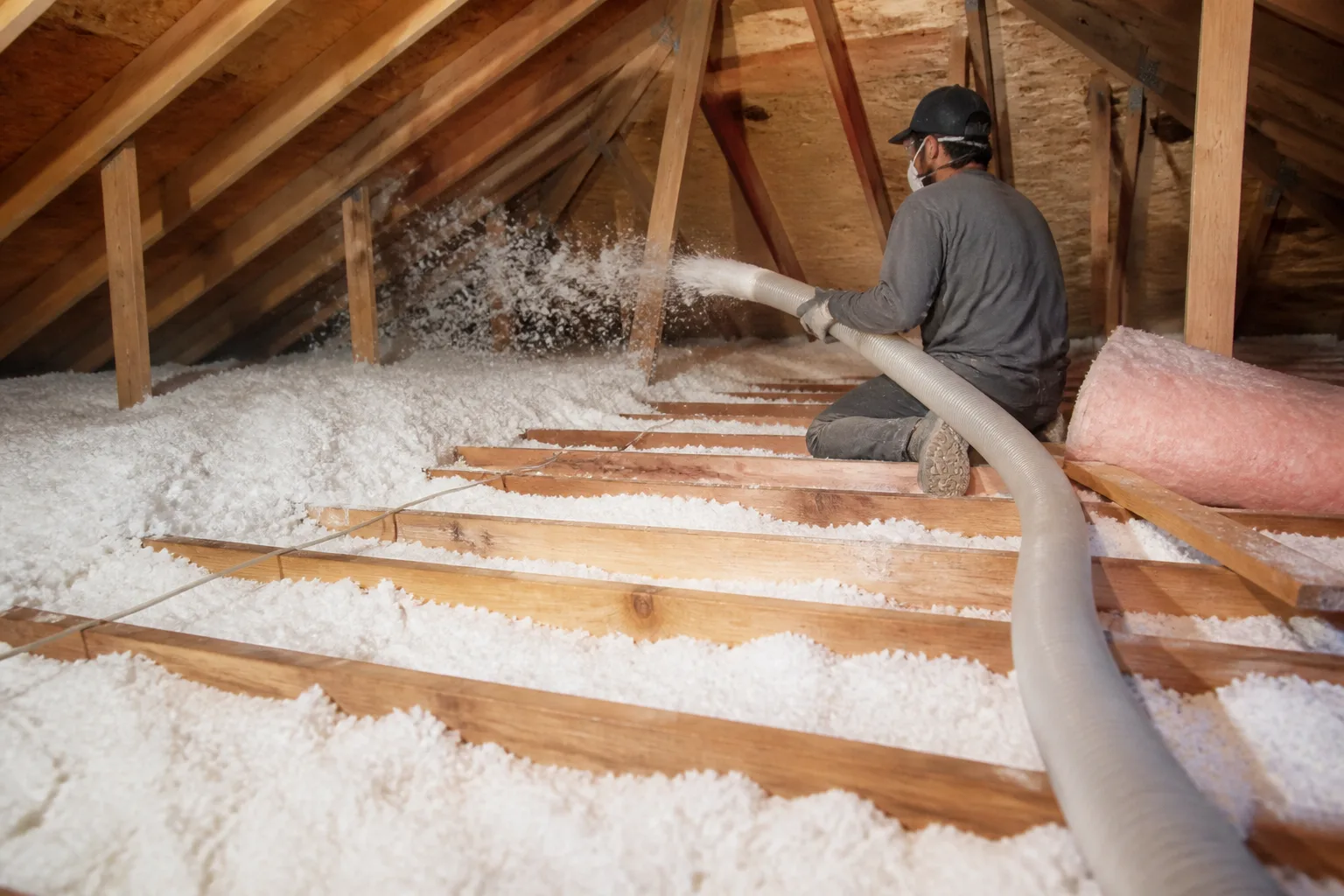
- Blown-in fiberglass: $1.10 to $2.20 per sq ft installed. Fast, effective, and the most common choice for open attics.
- Blown-in cellulose: $1.30 to $2.60 per sq ft installed. Slightly better air-blocking than fiberglass, and GreenFiber’s treated cellulose holds up well against pests.
- Spray foam (open-cell): $2.80 to $5.50 per sq ft installed. Best for finished attics or homes where the attic is part of the conditioned envelope.
- Spray foam (closed-cell): $4.50 to $7.80 per sq ft installed. Highest R-value per inch, moisture-resistant, and the most expensive option by a wide margin.
- Batts/rolls (fiberglass or Rockwool): $1.00 to $1.90 per sq ft installed. Makes sense for accessible attics with consistent joist spacing, not for tight or irregular spaces.
A 1,200 sq ft attic in Portola Hills getting blown-in fiberglass at R-44 typically runs $1,800 to $2,700. The same attic getting closed-cell spray foam can hit $6,500 or more. Both are legitimate numbers. The question is which one fits your home, your roof assembly, and your budget.
The Line Items That Separate a Real Quote from a Lowball
That low quote at $1.50 per square foot? It probably excludes four things. And when those four things show up as “change orders” halfway through the job, the final bill lands higher than the honest quote would have been in the first place.
Here’s what to look for in writing before you sign:
- Attic hatch insulation: The hatch or pull-down stair is a hole in your thermal envelope. Insulating it properly takes 1-2 hours and $150-$300 in materials. Lowball quotes skip it.
- Air sealing labor: Before new insulation goes in, penetrations around can lights, plumbing stacks, and wiring need foam or caulk. This is 3-6 hours of work on most Portola Hills homes. If it’s not a line item, it’s not happening.
- Existing insulation removal: If your attic has old, compressed, or pest-damaged insulation (common in homes built before 1990), it has to come out first. Disposal fees alone run $300-$700 depending on volume.
- Baffles at eaves: These keep insulation from blocking soffit vents so your attic still breathes. A Portola Hills attic with standard eaves needs 8-20 baffles at $6-$12 each installed. Skipping them means moisture buildup and mold in 2-3 years.
We pulled an old rat’s nest of compressed fiberglass out of a home in the canyon section of Portola Hills a few months back. The homeowner had gotten a quote from another company that looked great: $1,600 for blown-in insulation. But it didn’t include removal, didn’t include air sealing, didn’t include hatch work. The real scope came to $4,100. That’s not a bait-and-switch, it’s just a quote that ignored half the job. Ask for line items.
Why Portola Hills Homes Cost More Than Flat-Land Houses
Portola Hills isn’t a flat tract. The terrain shapes the houses, and the houses shape insulation cost. Here’s what we see across the 92679 zip code:
- Steep-pitch tile roofs: Most homes up here have concrete or clay tile at pitches from 5:12 to 8:12. Tile breaks if you step on it wrong. Crews move slower, stage materials differently, and sometimes need tile lifters on the roof. That’s labor time, and it shows up on the quote.
- Two-story plans with split attics: A huge share of Portola Hills homes have the furnace and main attic over the garage with a second, smaller attic over the upstairs hallway. Two separate attic spaces means two access points, two rounds of setup, and sometimes a second hose run for blown-in. Flat-access attic? One opening, one run. Split attic? Everything doubles.
- Limited access hatches: Older Portola Hills homes sometimes have hatches cut into hallway ceilings that are 22 by 30 inches. A standard half-sheet of plywood won’t fit through that. Crews hand-carry materials, and blown-in hoses get pulled through tight framing. It adds 1-2 hours on most jobs.
- Wildfire zone considerations: Much of Portola Hills sits in a Cal Fire Very High Fire Hazard Severity Zone. That affects building codes for vent screening and sometimes pushes homeowners toward mineral wool options like Rockwool, which is non-combustible. Fire-resistant materials run higher than standard fiberglass.
None of this means you’re overpaying. It means the local labor market is priced for local conditions. When you compare a Portola Hills quote to a quote from a flat, single-story home in Lake Forest, you’re comparing different jobs.
What’s Realistically Available from California Rebates in 2026
Let’s be direct about this: the federal 25C tax credit for insulation (30% of project cost, up to $1,200) is still active in 2026, and it applies to attic insulation as long as the material meets current IECC standards. That’s the cleanest money most Portola Hills homeowners can get.
Beyond federal, here’s what we’re actually seeing at the local level:
- SoCalGas energy efficiency rebates: Attic insulation rebates through SoCalGas have been intermittently funded. When active, they typically run $0.15-$0.25 per square foot for qualifying insulation upgrades. In 2026, funding windows have been short. Your contractor should be able to check current program status at quote time.
- SCE (Southern California Edison) programs: SCE’s attic insulation incentives have mostly rolled into whole-home energy upgrade programs rather than standalone rebates. If your home qualifies for a comprehensive upgrade (which often bundles insulation with other measures), the per-measure rebate can be meaningful.
- Contractor-applied discounts: The most reliable “rebate” right now is actually manufacturer promotions. Brands like Owens Corning, CertainTeed, and Knauf run seasonal contractor pricing that honest companies pass through. We apply whatever current manufacturer pricing applies to your job when we quote.
The key with rebates in 2026: don’t count on them until your contractor confirms current program status in writing. Funding cycles in California have been volatile. But do ask. A good insulation contractor stays current on what’s actually paying out, not what a government website said six months ago.
How to Get Three Quotes You Can Actually Compare
Here’s the problem we see constantly: a homeowner gets three quotes. One is $2,800. One is $4,400. One is $5,900. They pick the $2,800, then discover it was quoted for R-30 (below code for Climate Zone 8), didn’t include air sealing, and assumed no old insulation removal. Meanwhile, the $4,400 quote was R-49, fully sealed, with removal and new baffles. The $5,900 quote was spray foam, which is a completely different product serving a different purpose.
The fix is simple: put the same scope in front of every bidder. Here’s what to specify in writing when you request a Portola Hills attic insulation quote:
- Target R-value: R-44 or R-49 for most Portola Hills attics. Say the number.
- Air sealing included: Top plates, penetrations, can light housings, and the attic hatch. Say it’s required.
- Existing insulation handling: State whether removal is included, assumed, or priced as an option. Don’t leave this ambiguous.
- Baffle installation: Request baffles at every soffit vent bay. If a contractor says you don’t need them, ask why. Then get a second opinion.
With those four items specified, the quotes you get back will vary mainly by labor rate and material choice. And material choice is a much easier conversation when everyone’s bidding the same scope.
That’s honestly where a specialist helps. Homeward works across eight manufacturers because no single insulation brand makes the right product for every attic. A 1970s split-level with a tight attic needs something different from a 2005 two-story with a huge open truss attic. We stock and install fiberglass from Owens Corning, Johns Manville, CertainTeed, and Knauf; mineral wool from Rockwool; spray foam from Icynene and Demilec; and cellulose from GreenFiber. That’s not a flex, it’s just the practical reality of matching material to application. You can see more on our Attic Insulation in Portola Hills page.
If you’re anywhere near the point of saying “this is over my head,” that’s usually the moment to call someone. Insulation isn’t structurally dangerous the way electrical or roofing work can be, but a badly insulated attic in a wildfire zone is a real fire risk, and a badly air-sealed attic in a canyon microclimate is a moisture problem waiting to happen. When the job involves removing old material, dealing with tight hatches, or working around recessed lighting, we recommend a trained crew over a weekend DIY attempt. You’ll find our full service breakdown at Homeward Insulation Co home, and if you’re comparing methods, we’ve written dedicated guides on Spray Foam Insulation in Portola Hills and Blown In Insulation in Portola Hills.
The Bottom Line
Attic insulation in Portola Hills runs roughly $1.00 to $7.80 per square foot installed in 2026, depending on material and scope. Most homes fall in the $1,800 to $6,200 total range. The difference between a low quote and a high one is almost never profit margin. It’s scope: air sealing, old material removal, baffles, hatch work, and whether the attic is one easy space or two tight ones.
Get your quotes in writing, make sure the four scope items are specified, and don’t pick the cheapest number just because it’s the cheapest number. If you’re in Portola Hills and want a quote that includes everything the first time, give us a call at (855) 473-6516. Estimates are free, and we’ll tell you plainly what your attic needs and what it doesn’t.
Frequently Asked Questions
Attic insulation in Portola Hills typically costs between $1,800 and $6,200 total in 2026, with most homeowners paying around $3,400 for a standard R-44 blown-in job. Your specific price depends on attic size, access difficulty, whether old insulation needs removal, and the material you choose. For an exact number, call (855) 473-6516 and we’ll give you a free quote with line items.
Fiberglass is usually cheaper. Blown-in fiberglass runs $1.10 to $2.20 per square foot installed in Portola Hills, while blown-in cellulose runs $1.30 to $2.60 per square foot. The 15-20% difference is modest, and cellulose offers slightly better air-blocking performance. For most open attics, either works well at R-44 to R-49. Call (855) 473-6516 and we’ll talk through which one fits your house.
Yes, in most cases. Attic insulation is not a multi-week project. A typical Portola Hills attic takes one day for blown-in material or two days if old insulation removal and air sealing are included. The main variable is scheduling, which gets tighter in spring and fall when energy bills spike and homeowners start thinking about comfort. Call (855) 473-6516 to check current availability.
The federal 25C tax credit covers 30% of attic insulation costs up to $1,200 in 2026. SoCalGas and SCE programs exist but funding windows have been short and unpredictable. The most reliable savings right now come from manufacturer promotions that contractors can pass through at quote time. Ask your contractor directly whether current local rebates apply to your project before signing.
Written by the team at Homeward Insulation Co, serving Portola Hills since 2012.
Need Insulation Help?
Call Homeward Insulation Co — licensed & insured, here with fast after-hours help in Portola Hills.
(855) 473-6516